Re: What Happened To Channel 1
His recitation of history is factual.
He is *NOT* accurate with regard to 'cause and effect' of 'detent' tuners leading to "channel number" common-usage. Detent tuners were at least 'second generation'; the prior generation (analog continuous-tune) sets all used _numbered_ channels,
Crosley, in those days, was a "high end" manufacturer. If a high-tech, 'detent' tuner design had been available, they *would* have been using it.
Thus we've got numbered channels (_without_ frequency numbers) in "common use" well before any 'detent' (turret switching, or other) tuners were in vogue.
In the -very- early days stations _were_ identified by the frequency/ frequencies they transmitted on, There wasn't any option on the matter, since it was being done under experimental provisions of _amateur_radio_ licenses, and where they were broadcasting could change from day to day. :) But this is WW-I era.
Actually it was surprisingly easy. Not even as hard as tuning an AM receiver. Or use the markings on the dial to get 'close', then you ignore the markings and tweak for maximum clarity. All it takes is "reasonable" gearing. :)
Add in two-stage gearing -- the first few revolutions in either direction were moved the frequency in small increments, once the 'limit' in either direction was reached, things went much faster. Thus, when you overshot a "little bit" on the first attempt, you had "automatic" fine-tuning as you started going in the other direction. Somewhat complex mechanically, but amazingly easy to _use_.
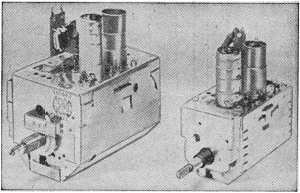
Yuppers. 'Practicality' strikes again. 70 UHF channels would have meant a detent roughly every 5 degrees of rotation. A 70-sided turret, with circuit strips that were only 1/2" wide, would have had to be nearly a _foot_ in diameter. Gotta wait for a better technology. :)
Sometimes a tuning slug in a coil, often a trimmer capacitor. Either way, it provides a frequency adjustment over a limited range, with relatively high precision and stability.
Sets with this kind of fine tuning could _almost_always_ be identified by the fact you had to 'push in' the fine-tuning knob/ring to engage the adjustment mechanism on the 'active" turret segment.
B&W only, a roughly 11" _round_ tube, medium-lousy contrast range, moderately long-persistence phosphor, and a few other drawbacks -- hardly worth the trouble. :)
And, of course, no 75-ohm coax input. Would have had to use a balun on the twin-lead screw terminals. ;)
*nice* audio, though.I don't think anybody selling into the U.S. market at the end of WW-II was making a continuous-tuning model. Turret tuners were simpler/easier/ cheaper to manufacture, once you worked out the right combinations of resonant frequencies and band-pass filters.
And *much* more "user-friendly".
What science can take away, science can put back. Those traps did _not_
*completely* eliminate the signal getting into the customer premises, they just made it so weak that a conventional TV set couldn't amplify it enough to make a decent picture. A decent high-gain single-channel pre-amp, on the other hand, installed 'in front of' the TV receiver, could do a surprisingly good job of resurrecting the 'killed' signal. read more and respond »Posted 5 years ago by Robert Bonomi in General Telecommunications Forum